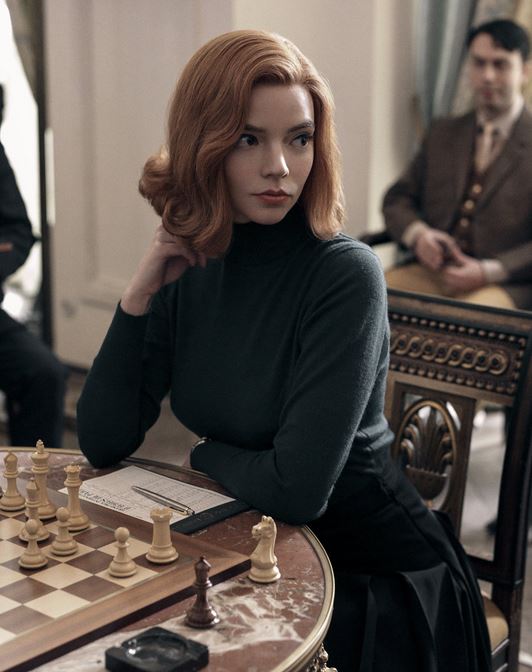
So everyone likes a good chess story from Searching for Bobby Fischer to…ok, I don’t know that many other chess stories, but that movie’s great. The Queen’s Gambit is a good chess story, because even with my VERY limited knowledge of chess, I feel like it’s exactly how a chess mind would write their own story, full of subtle nods the lack of emotional intelligence people with high enough IQs to be good at chess might have, matched in incompetence only by their brilliance for the probability analysis of the game. As the last episode wrapped up, I found myself saying “that’s it?” It’s because my limited, over hyper, lack of focus, honestly spastic approach to solving problems and generally living my life doesn’t understand the methodical and subtle approach that most careful geniuses take to their craft. I really only obsess over obsessing over things, so careful tact, developed over years is something I’m wholly unfamiliar with.
The promos and early episodes paint the picture of a fast paced bildungsroman of a young girl, played by Anya Taylor-Joy, an actress probably best known for her role in the absolutely terrifying vision of a film The Witch that gives this New Englander a shudder every time he hikes in the woods near his Massachusetts home. She begins in the second episode as the aged up, Beth Harmon, an orphan being raised in a late 1950s era girls orphanage as a young teen, clearly with a genetic disposition towards addiction, the real life dark passenger for many, interrupting their success as they do for young Beth. She finds the game of chess through a wily, firm janitor in the first episode, ultimately putting on a show at local high school, beating twelve older chess club teens at once and gaining tepid acclaim from her peers and orphanage overlords. Beth also can’t stop herself from seeking this pill she originally was prescribed at the orphanage, some sort of tranquilizer that gets cut off when the state realizes it’s deleterious effects on its service units, the children. Beth spends the next few years cutoff from her lifeblood of chess, after overdosing on the drug, before being adopted by a very basic couple, who seem mildly interested in her existence. The family implodes while Beth finds her way to local tournaments that turn greater and greater in scope as she works her way up in the chess world. All the while she struggles with an ever permissive environment, partly by her literal aging, but also by the world at the time in the late 1960s setting where her addictions can be fed as her success grows. She makes friends along the way, pretty much all male who help and support her, pushing her to finally defeat her Soviet foe in a culminating tournament for the world title. It plays out like a sports movie, but there’s so much in this show to appreciate the kind of people who see chessboards on their ceilings.
Addiction can be one of the easiest and most difficult subjects for any art form to explore because it comes in so many different forms, but also is really the same thing for everyone that experiences it. The Queen’s Gambit isn’t meant to be a show about addiction like countless other films, TV series and books or at least it doesn’t approach it from the typically over the top, excessive, Motley Crue style, so common in other work. Part of this arises from the setting of middle America in the late 1950s through the 1960s, where pill popping and day drinking gave women especially, some sort of escape from the haunting pre-determined timelines of their lives. Beth Harmon doesn’t project the outward mess that many addicts do, at least from the outset, but uses medication to give her a perceived calming edge in the high stakes games of chess she can’t live without playing. Of course her addiction evolves to a place where her functionality struggles, but nothing about this show gave me the impression over typical depictions of outright addiction. That’s not a disservice to the portrayal of addition because the subtle ways that Beth’s disease seep into her life are more realistic than being in a fucking rock band. Her genius doesn’t preclude to her disease and the series really gives us again a subtle indication of the genetic role through her mother, a very well educated university professor, clearly unhinged by her own demons. I’m always fascinated by the madness of genius, where one part of the brain works so much better than everyone else, the rest largely left to decay. It’s clear her mother had some sort of similar condition, but rather than over dramatizing her mother’s condition, flashbacks of screaming, drunken, unhinged outbursts or intense physical abuse, Beth’s memories of her mother are so much more realistic, like ours. I’m bothered in media when memories or dead people just appear and haunt people, not in any sort of ghostly sort of way, just physical manifestations that appear to them, an obvious parallel to real life where people are haunted by the people they’ve lost. I have no familiarity with that, everything I remember from being as young as her is a flash and with this show, Beth compartmentalizes those flashes, because who really remembers things that well from their childhood. Her flashes give her strands to understand her own condition, often what most of us have to go on with our own parental trauma, something I found intensely pedestrian in a good way in this made up story of a chess genius.
That pedestrian part of this story makes it so compelling to me because it lacks the flare of other stories of genius where intensely focused memories leave a trail of breadcrumbs for the protagonist to find their way towards an explanation for why they are. I work with a lot of accountants and they appear on the surface a lot like Beth, reserved, calm, slow to evoke emotion and intensely smart. We so often see extroverts grapple with success, but this story was about an introvert, with so much more going on in her head than she expressed despite her problems through a chaotic life. Anya Taylor-Joy’s performance made all of this possible in one of the most esoteric roles I’ve seen someone play in a major series. She captures that subtle genius that’s reticent, while confident, brash, yet sheepish in her victories, content with demonstrating her skill, earning the win, without concern for the attention garnered. She really struggles throughout the story with her personal relationships, most with men she plays in chess, in awe of her skill, confounded by her prickly disposition. It’s her addiction and failures that make her realize the reality of being human, something she seems uncomfortable with throughout the story. In these failures, she finds her boys there for her to help in any way they can, all of them of course, former opponents she steamrolled. While the series doesn’t embrace an over the top approach to addiction, it does lend credence to the importance of a network of people around it’s main character who care, whether based on chess skills or personal affection. Beth’s boys, some of which were lovers, don’t view her in any sort of way other than as a person they care for who needs them. It’s really sweet and genuine and in this age, somewhat of an outlier as men of an older generation are portrayed in an increasingly menacing way. Chess, the center of this story, exposes all in terms of ability and I genuinely believed how well these guys, who eventually took care of Beth at times, took to her beating their asses. Even her Soviet rival, Borgov, authentically appreciated and expressed his admiration for her genius as a player, having bested her multiple times before. That’s the point of this story, the human side of genius. Of course we got the chessboard on the ceiling, to show us how her mind wove patterns in thin air, playing her game whenever she wanted, despite those times where she didn’t even play, but her strife and how she responded to it made her story relatable to us pawns. It’s a story about respect. Borgov clearly sees her flaws when she chugs water, trying to cure a hangover in their second match and seems honestly relieved at her kempt appearance and performance when she beats him in the finale.
Along with Beth’s pedestrian background, I was struck by how little we see outwardly uninteresting people portrayed. Beth doesn’t seem like a life of the party person and again, I know a lot of accountants like her. Her greatness isolates her as many with that type of brain feel, vagabonds in their own thoughts, foreign to all around them, tethered only to their obsessions. She’s fortunate to find the janitor as a child and her ability grants her access to men who respect her unique abilities in chess. Her relationship with the janitor is especially realistic because while he teaches her the game and funds her first tournament, she largely ignores him because she’s not capable of being an emotionally attached person. Each relationship she has is strained because she’s unwilling to contribute, except for that of the janitor who really understands her. He clips her achievements, something she discovers after his death, showing care in the old school way people did in the 1960s; admiration from afar. It was perfect that he did because she only ever wanted that kind of relationship with people, transactional, like that of her adopted mother and the janitor understood as well, appreciating his role in her success without pining for any sort of recognition.
Part of the portrayal of Beth’s seemingly cold disposition owes to the creative, I’ll call it responsibility in 2020 of portraying women in art. I believe this series did an incredible job focusing on Beth as a person, from her own perspective as a great chess player without regard for her gender. She doesn’t make a big deal about it at all and is genuinely surprised at the feminine fan fair she gets, which I assume some people would see as a failing given that she should be championing her gender. I’d disagree since it’s not in her character to do that or be concerned with it. She quickly gains the respect of her male rivals, all of whom underestimate her to a degree, but ultimately respect her love and skill for the game. Even when she does become intimate with one of her “teachers”, the relationship doesn’t derail the series because Beth treats it like everything, a necessary pleasure to keep her mind and body in the game of beating Borgov. She’s not exactly uptight, she just generally lacks interest in other people, short of their ability to help her get better. I definitely appreciate this somewhat cold hearted portrayal of a young woman, given how often and exalted male roles of similar nature can be. During the final matches in the Soviet Union, it was her boys cheering her on, listening intently and rooting for her, something she started to realize an appreciation for as she mowed down Soviets. I think a lot of people might have been bothered by her lack of sexuality, given that she’s a young attractive woman, but I just found it refreshing that we scarcely had to think about it and instead could focus on her personal journey, dealing with her trauma, in conjunction with her rise in the chess world. These men also helped show us how incredibly difficult it is to be good at chess and showed us a little bit of the sausage making of a phenom. While you largely expect her to win on the big stage (and she mostly does), I love how they do post mortems for her losses and the process of understanding why she lost. In sports, many coaches and players don’t do this to an appropriate extent, instead focusing on superficial moments of emotional flare or otherwise as excuses. Beth’s friends helped her understand her losses to study them. Her lack of general interest in other people had to be softened to an extent for her to gain the valuable knowledge. Too often, phenoms are presented without any sort of focus on how much work and effort they do; it seems completely natural and gifted, an incredibly dangerous idea when applied in the real world in certain ways. The Queen’s Gambit showed their work (unlike the last season of Game of Thrones), in very succinct ways that gave us chess lay people the perspective on the effort required for Beth to pull off what she ultimately does. When her work pays off, a part of it due to her friends help, it made me really happy to see how overjoyed her friends were with her victory because it was authentic, largely platonic and represented the innate connection people have through the things they love, something I think many of us have missed in 2020.
The final aspect I’m conflicted about when it comes to this series is whether the ending was sappy or just right. It’s almost in the Goldilocks zone for me, but ultimately I believe it just barely misses the landing. Throughout Beth’s time in the Soviet Union, she had little contact, save her friend Townes and appeared so measured and focused on not drinking that I think she lost a bit of the subtleties that made her character so quietly dynamic. I’ll give them credit that they didn’t go for the Lucifer in the garden of Eden bit, having someone try to force booze on her, though I also felt that they seemed to coldly expect us to believe that she just kicked a decade old drug and alcohol habit, pretty much cold turkey, without any sort of exploration into that battle. Maybe Beth wouldn’t have wanted that seen, though in the throes of her addiction, there’s not much we didn’t see. I just needed something from her time in the Soviet Union where she seemed vulnerable. My guess would be that her tribulations throughout her life, toughened her up to the point where she collected those experiences and channeled that focus into beating Borgov. She taught herself to focus without the tranquilizer drugs and like many real life musicians, learned to lean on her talent rather than substance. Her own sticktoitiveness, tenacity, grit and intellect, previously attributes she might have doubted at times, were fully realized in fulfilling her destiny and conquering her greatest foe. I mentioned before the portrayal of mastery in this series, one that much of art bypasses, bewitching viewers with the false notion that genuine inherent talent trumps all else so it does make sense that through everything she goes through, her self-realization would turn her into the perfect form of herself, free from addiction (at least long enough to beat Borgov) and confidently her polished self . It could be a good thing that the finale gave me enough thoughts to provoke that explanation, but I do tend to believe that the writers had an end in sight and needed to get there without distractions. Not sure exactly how you get us anything more satisfying, I just think there was something missing. Either way, I really enjoyed her journey and not just the matter of fact portrayal of her as a woman in a man’s world. We often see the madness of genius in art, however we don’t often see the quiet genius, introverted by nature and generally unconcerned with other people unless forced to, driven by some sort of madness melded with the hard work of mastery, who find herself so realistically in a final place of self-awareness that you believe how she got there.
 Bo's Gamut