Heads up, this contains Spoilers of both Ex-Machina and Annihilation
So after what seems like years of attempting to sit down and actually watch Annihilation, quarantine itself finally stepped in and forced my hand. The movie is a loose adaptation of the first book of Jeff VanderMeer’s Southern Reach Trilogy and stars Natalie Portman, Jennifer Jason Leigh, Tessa Thompson, Gina Rodriguez, Tuva Novotny and Oscar Isaac. Without knowing it, I’ve unknowingly appreciated the director and writer Alex Garland for some time. Garland, a frequent collaborator with Danny Boyle, wrote the only interesting zombie drama story I enjoyed, 28 Days Later, (glad the zombie fad is finally waning) and I’m always here for The Beach, Boyle’s self regretted movie that I saw like twelve times during random stints of free HBO in my adolescence based on Garland’s book. I didn’t realize the connections between these projects, but as I looked into Annihilation, I realized Garland wrote and directed Ex Machina, wrote The Beach novel, and created Devs, a show I had just started, mostly to see not funny Nick Offerman (he’s still funny on that show). I’m enthralled with Garland’s shift towards neo-modern sci-fi and Annihilation fits right into the crest of his career wave. Side note on Oscar Isaac and Alex Garland; the pair have potential to be this generation’s David Lynch and Kyle Machlachlan; seriously the way Oscar Isaac looks at people, his face at once contains all of his emotions, while simultaneously absorbing those of the other actors around him like a two-way mirror. His eyes slice viewers with uncomfortable feelings as seems to look past the camera at the viewer, almost as an omniscient deity. This movie however, deliberately doesn’t overly focus on him or any men really, a ploy I ultimately understand I guess, but I doubt many viewers came to the same conclusion I did.
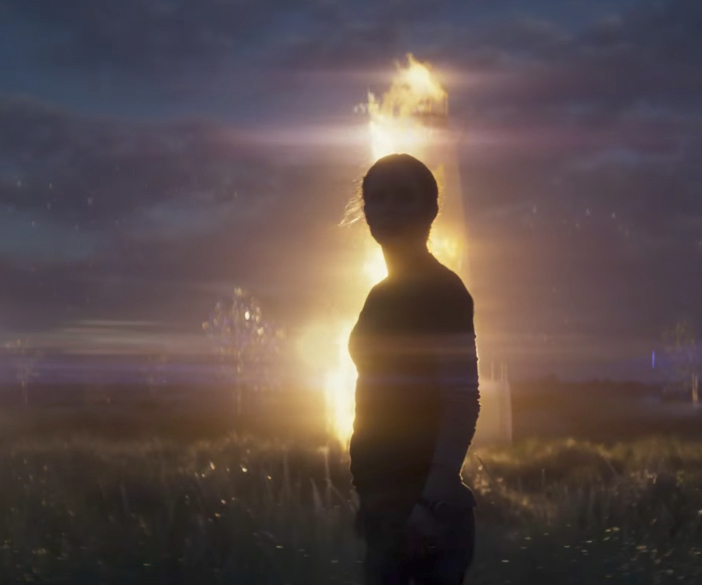
This film begins with Natalie Portman’s Lena, a doctor of biology at Hopkins and former Army servicewoman, mourning the disappearance of her husband Kane, played by Garland’s muse Oscar Isaac. Kane returns from being MIA on a secret military mission, but he isn’t the same and Lena can tell. While at their home, he falls ill and as they rush to the hospital, Lena and Kane are accosted by unknown military personnel and kidnapped. They’re taken to “Area X”, a giant effervescent blob emanating from a lighthouse that appears to be somewhere in the Mississippi delta. Jennifer Jason Leigh’s Dr. Ventress enlists Lena to investigate the blob and assigns her to a group of other female scientists and Gina Rodriguez’s Anya. Kane had been part of an all male military team that entered the blob, but to Ventress’ knowledge no member had returned, hence the kidnapping. The group of scientists will enter the blob to research what’s happening in there and possibly offer something different than the previous all male, military groups that went in. Interluding throughout the film are interrogation interview scenes with Lena, clearly postmodern from the primary events of the film. Each member of the group comes from a different scientific background including Lena (cellular biology), Josie (physicist), Cass (geomorphologist), Ventress (psychologist) and Anya. I still can’t figure why Anya is there? Is she supposed to be the muscle of the group? I’m assuming she’s more than a paramedic, maybe former Army or Delta Force, but seriously, if she’s there as medical support, I can’t see how no branch of the military can offer an actual female doctor with combat experience at least in this fictional world. I can’t say I believe she’s there because she can handle a gun and has life saving skills either, but regardless of her qualifications, the group enters the blob and ensues.
While in the blob, through a series of mishaps, some intentional or seemingly random and others self-inflicted or at least self-determined in the case of Tessa Thompson’s Josie (who I guess just turns into a shrub?), each member of the group falls victim to the effects of the changing environment in the blob that also appear to alter their biology in visually disturbing ways, but also in heavily implied, though sparsely explored psychological aspects. Throughout these misadventures, Lena reveals her disciplined Army training as the only member who confidently handles her gun, bailing them out at times from grotesque, mutated animals. I really figured that this movie might follow a different path, however it got some marketing as a horror flick and while I mostly don’t like horror movies, it delivered on that I guess with some gory, gross deaths. Still I slightly judge people who need violent death in a movie for it to be entertaining; it’s weird, just admit it to yourselves.
Penultimately, after Lena learns her real husband self-immolated using a fire grenade, subsequent to beseeching a doppelganger of his to find her, Lena faces down a visually stunning alien life form after it absorbs Dr. Ventress in a sequence offering exquisite effects, a worthy pay off of the magnetic, visual teases previously in the film. The alien uses a vial of her blood to take a human shape and appears to be Lena or at least mimics her, though as she describes it in her interrogation interludes, she wasn’t sure the alien knew Lena was there, though it repeatedly won’t let her leave. As she battles with the alien copycat, bludgeoning the viewer over the head with the “our greatest battle is against ourselves” theme, she ultimately fools the creature into igniting itself on fire in the same manner she saw her husband do to himself and the alien comically sets its entire lair a flame, causing a Night King like effect for the entire blob, as Lena follows the beach out. The final scene sees Lena embrace fake Kane and as his irises twirl around in a sinisterly alien manner, signifying his parasitic possession, then follows the camera panning to her eyes doing the same, obviously.
I still don’t understand the why of this movie and what I’m supposed to glean from it. Despite its flaws, the questions it posits, qualify it as a quality film ripe for discourse. As I alluded to earlier, I think many, including the writers viewed this as a pro-female, slightly feminist story, as men in this movie are literally accoutrement, interrogators, swat teams or Oscar Isaac; all aggressors in some way. The obvious slant, other than the team of genius women and Anya, is that all previous missions into the blob of men failed and as the women discover, those hardy groups either went insane and destroyed themselves or the environment “annihilated” them. The premise of the film’s central mission given the uncertainty, is to see if gender plays a role in success, but don’t they ultimately fail in their mission? Lena laments in her final interrogation that the alien just wanted things to change around it, not make them worse, just different. All well and good, but if Lena came back an alien with her and Kane as proto-changelings, are they going to make things better? Did she as the woman, not the man, succeed in the message of change? I’m not sure what the definition of success is in the film. Lena lived, though she knows her husband is different but at least she has closure and the blob went away. She also killed the possibly amiable alien. Maybe, or if this really is horror as her gyrating iris revealed, did the killer fool everyone, escape out into the world, which by the way is exactly how Garland’s Ex Machina ends. Depends on how you look at it, but I do think Garland or really VanderMeer may have stepped on his own message (disclosure: I haven’t read the book), as the women really did succumb to their own selfish humanity as men always do, destroying the vehicle for real change or at least deceptively planning to alter those around them as Lena and Kane clearly will.
Of course the other theme is the environment and our treatment of it, which I do have to say doesn’t have the banal presentation as the horror tropes do in this film, including the “monster alien who just wants to be friends”, though it absorbs Ventress, turns Josie into a bush, burrows some snake thing into a guys stomach (maybe it’s there to keep his abs trim, change for the better?), pushed real Kane to kill himself and basically assaulted Lena. The alien seems to desire nothing other than as Ventress describes it, in a cringeworthy HEY THIS IS THE NAME OF THE MOVIE RIGHT HERE line, annihilation. I’d throw this line’s candidacy in for the hall of fame of movie lines where a character dramatically says the name of the movie. As Lena discovers though, the alien seems to have an infantile innocence, enough to have it willingly stare at a fire grenade in its hand as she escapes its suffocating closeness. Our environment presents itself to us in much similar ways, destructive as possible in isolated circumstances with water damage, animal attacks, famine and just about everything else the earth does to fight back, but on a global scale, it’s ultimately in our hands. If we wanted to, our dominion over nature could be almost absolute and lord knows we keep trying. I appreciate the way the story approaches this perspective that our environment destroys that which doesn’t deserve its elegance. The team of women are scientists, hoping their various disciplines will help them understand what’s happening in the blob and their intent is one of exploration, not aggression (again the message of female diplomacy vs male belligerence is distorted as the women fall into violence themselves against each other), but the environment still doesn’t care and attacks them. It’s a complex argument for our consideration of this world, one which isn’t entirely apparent in the veil of the horror bent of this film. Ultimately, I believe the film parallels our own reactions to climate change. An alien environment slaps viewers in the face (unlike slow moving climate change in real life) and we like the characters initially react with aggression or maybe denial at first like the male teams. We then attempt to study and understand as the women do, but ultimately men and women together (humanity) are responsible for how we treat the planet. Maybe together with our new, whirling eyes we can treat it better.
 Bo's Gamut